Blind Test
A screening test that checks your color vision is often done early in a comprehensive eye exam to rule out color blindness. In addition to detecting inherited color vision deficiencies, color blindness tests can also alert your doctor to possible health problems. Inform the eye that may affect your color vision.
Eye movement test (eye movements)
The eye movement test is done to determine how well your eyes can follow a moving object and/or move quickly between two separate targets and accurately fixate on two separate targets. "chasing") is more common. The ophthalmologist will ask you to hold your head still and follow the slow movement of a hand-held light or other target with only your eyes.
If rapid eye movements ("saccades") are also tested , your eye doctor may ask you to move your eyes back and forth between two targets that are a short distance apart. Eye movement problems can cause eye fatigue and affect your ability to read, see sports, and other things. Skills affect.
Testing a steriopsis (perceived depth)
Stereopsis is a term used to describe the set of eyes that allow natural depth perception and the perception of the three-dimensional nature of objects.
In one commonly used stereopsis test, a pair of "3D" glasses You click and look at a booklet of test patterns. Each pattern has four small circles and your task is to determine which circle in each pattern is closer to you than the other three circles. If you can correctly identify the "closer" circle in each pattern, you likely have excellent eye-teaming skills that allow you to experience natural depth perception.
Retinoscopy
In retinoscopy, the room is dimmed and you are asked to focus on a large target (usually a large "E" on the eye chart). As you stare at the "E," the ophthalmologist shines a light into your eye and rotates the lenses in a machine in front of your eyes. This test estimates which lens power will best correct your distance vision.
Determining refractive errors
During refraction, the doctor will place a device called trial lens or phoropter in front of your eyes and show you a series of lenses. Then he will ask you which of the two lenses looks sharper in each choice. Based on your answers, your eye doctor will continue to fine-tune the power of the lens until you reach the final version of the glasses.
Refractive surface It determines farsightedness, nearsightedness, astigmatism and presbyopia.
Examination of Slit Lemopi
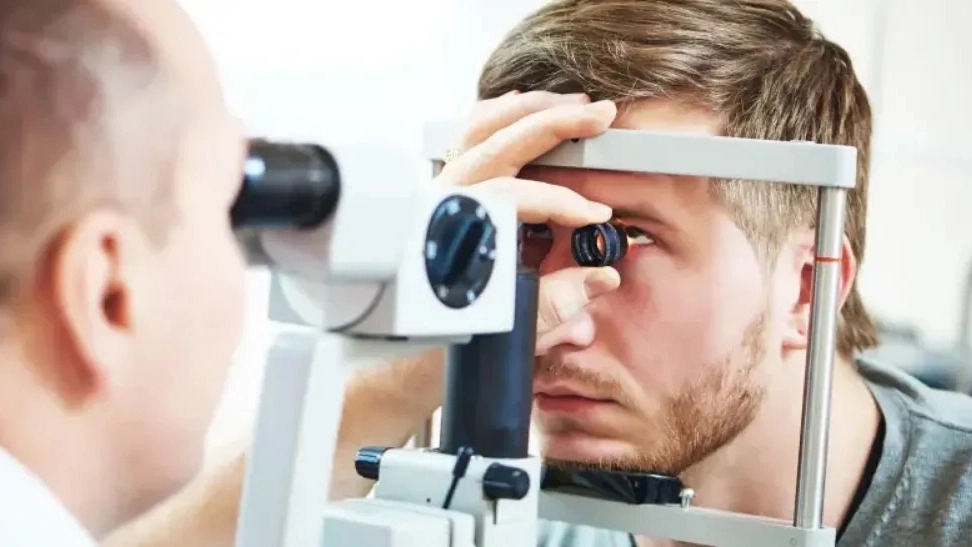
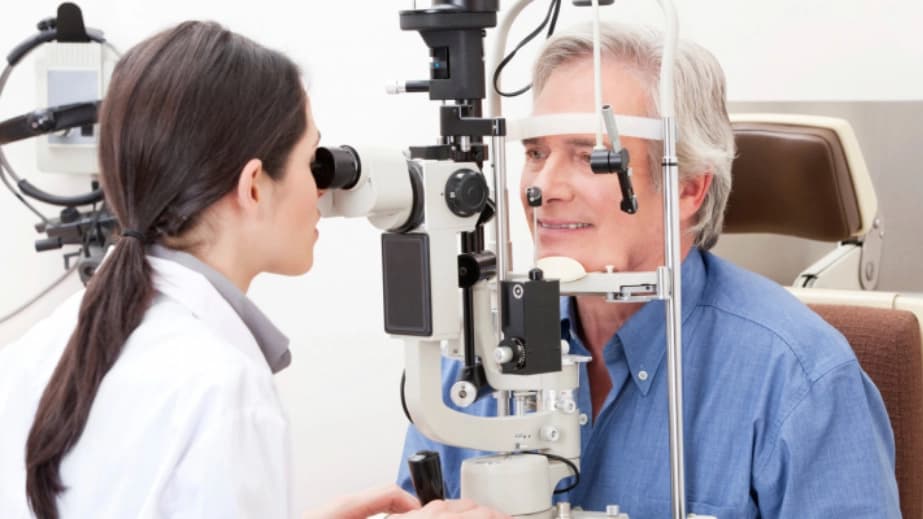
A slit lamp is a binocular microscope (or "biomicroscope") that your eye doctor uses to examine the structures of your eye under high magnification. It is somewhat similar to a large, upright specimen of a microscope used in a scientific laboratory.
During a slit-lamp examination, you will be asked to rest your forehead and chin securely against supports. Place the instrument in front of you, and the doctor will begin by examining the structures in front of your eyes – including the eyelids, cornea, conjunctiva. Iris and lens.
With the help of a hand lens, your doctor may use a slit lamp to examine structures farther in the eye, such as the retina and optic nerve.
A wide range of eye diseases and conditions can be diagnosed. By examining the slit lamp, he diagnosed, including cataracts, macular degeneration, corneal ulcers and diabetic retinopathy, etc.
Glaucoma test
A glaucoma test usually begins with a measurement of intraocular pressure. A common glaucoma test is the "air puff" test, technically known as non-contact tonometry. NCT
For NCT, the test starts by placing your chin on the chin section of the machine. While you look at a light inside the machine, the doctor or a trained assistant will blow a small burst of air into your open eye. It is completely painless and the tonometer does not touch your eye. Based on the resistance of your eye to the puff of air, the device calculates your intraocular pressure (IOP). If you have high eye pressure, you may be at risk for or developing glaucoma. Another type of glaucoma test is done with a tool called an applanation tonometer. The most common version of several versions of this instrument is installed on a slit lamp.